- Welcome to Al-Mawaleh
- Majan building , Opposite CSK cafe ,Ghala,Muscat Governorate,Sultanate of Oman

Al Mawaleh delivers professional artificial intelligence services in Oman, helping businesses harness the power of AI to automate operations, generate actionable insights from data, enhance customer experiences, and build the intelligent capabilities needed to compete effectively in Oman’s rapidly evolving digital economy.

Artificial intelligence services encompass the design, development, and deployment of intelligent systems and solutions that enable machines to perform tasks that would traditionally require human intelligence. These tasks include recognizing patterns in data, making predictions, understanding and generating language, automating complex decision-making processes, and continuously learning from new information to improve performance over time.
For businesses in Oman, AI services cover a broad and practical spectrum of applications. From automating repetitive back office processes and building intelligent customer service tools to developing predictive analytics capabilities, implementing computer vision solutions, and creating data-driven decision support systems, artificial intelligence is transforming how organizations across every industry operate, compete, and serve their customers. Professional AI services provide businesses with the strategy, technical expertise, and implementation support needed to move from AI awareness to genuine AI capability in a structured, purposeful, and commercially grounded way.
Oman is actively positioning itself as a regional hub for artificial intelligence and digital innovation. Oman Vision 2040 explicitly identifies AI and advanced technology as strategic priorities for national economic development, and the government has made substantial investments in AI infrastructure, digital skills development, and technology-enabled public services. For businesses operating in Oman, this national commitment to AI creates a compelling environment in which early adoption of artificial intelligence delivers competitive advantage, alignment with government priorities, and access to a growing ecosystem of AI talent and infrastructure.
Beyond the national strategic context, the business case for AI adoption in Oman is immediate and concrete. Businesses that integrate AI into their operations consistently achieve measurable improvements in efficiency, cost reduction, decision-making quality, and customer satisfaction. As competition intensifies across every sector of the Omani economy and customer expectations continue to rise, organizations that leverage AI effectively will consistently outperform those that do not. For businesses in Oman that are serious about long-term competitiveness and growth, investing in professional AI services is increasingly a strategic necessity rather than an optional innovation experiment.
Organizations of every size, sector, and stage of development in Oman can benefit from structured AI services and implementation support:
AI Strategy and Readiness Assessment
Before implementing AI solutions, businesses need a clear understanding of where AI can deliver the greatest value, what data and infrastructure foundations are required, and how to sequence AI adoption in a way that generates early returns while building toward longer-term capability. Al Mawaleh develops tailored AI strategies and readiness assessments that give organizations a clear, realistic roadmap for AI adoption aligned with their specific business objectives, data maturity, and resource capacity.
Process Automation and Intelligent Workflows
Many businesses in Oman continue to rely on manual, repetitive processes that consume significant staff time and introduce unnecessary risk of human error. Al Mawaleh implements intelligent process automation solutions that use AI to handle structured and semi-structured tasks across finance, HR, operations, customer service, and administration, freeing staff to focus on higher-value activities that genuinely require human judgment and creativity.
Predictive Analytics and Business Intelligence
Predictive analytics uses AI and machine learning to analyze historical and real-time data, identify patterns, and generate forecasts that help management make more informed decisions about demand, risk, resource allocation, and business performance. Al Mawaleh develops and implements predictive analytics solutions that transform raw business data into actionable intelligence that management can use to anticipate challenges and capitalize on opportunities before competitors do.
Natural Language Processing and Conversational AI
Natural language processing enables computers to understand, interpret, and generate human language in ways that are practical and valuable for business applications. Al Mawaleh develops NLP-powered solutions, including intelligent chatbots, automated document analysis tools, sentiment analysis systems, and virtual assistants that help businesses automate customer interactions, extract insights from unstructured text data, and deliver more responsive and personalized service experiences at scale.
Computer Vision Solutions
Computer vision technology enables machines to interpret and analyze visual information from images and video in ways that support a wide range of business applications. Al Mawaleh develops computer vision solutions for quality control, security monitoring, document processing, inventory management, and other use cases where the ability to automatically analyze visual data delivers significant operational value.
AI Integration and Custom Development
Many businesses require AI capabilities that are integrated into their existing systems and workflows rather than deployed as standalone tools. Al Mawaleh provides custom AI development and integration services that embed intelligent capabilities directly into your current technology environment, ensuring that AI solutions enhance rather than disrupt established operational processes.
| Service Type | Estimated Timeline | Cost Range(OMR) |
|---|---|---|
| AI opportunity assessment and strategy | 3 to 5 weeks | Customized quote |
| Process automation implementation | 4 to 10 weeks | Based on process complexity |
| Predictive analytics development | 6 to 14 weeks | Varies by data scope |
| Conversational AI and chatbot development | 4 to 8 weeks | Customized quote |
| Computer vision solution development | 6 to 12 weeks | Based on application complexity |
| Custom AI integration and development | 8 to 20 weeks | Customized engagement proposal |
AI service timelines and costs vary significantly depending on the complexity of the use case, the maturity of your data environment, the level of integration required, and the scope of the solution being developed. Contact Al Mawaleh for a transparent, tailored proposal based on your specific AI requirements and business objectives.
Operational Efficiency at Scale
AI-powered automation eliminates the time, cost, and error risk associated with manual processing of repetitive tasks, enabling businesses to handle significantly greater volumes of work without proportionate increases in staffing or operational overhead. The efficiency gains from well-implemented AI solutions compound over time as the systems learn and improve continuously.
Superior Data-Driven Decision Making
AI gives management access to analytical capabilities that far exceed what human analysis can achieve on large and complex datasets. Patterns, correlations, and predictive signals that would take human analysts weeks to identify can be surfaced by AI systems in minutes, enabling faster, more confident, and more accurate business decisions across every function.
Enhanced Customer Experience
AI enables businesses to deliver personalized, responsive, and consistently high-quality customer experiences across every touchpoint at a scale and cost efficiency that would be impossible through purely human service delivery. From intelligent chatbots that resolve customer inquiries instantly to recommendation engines that surface relevant products and services, AI transforms the customer experience in ways that build loyalty and drive revenue.
Competitive Differentiation
Organizations that successfully integrate AI into their core operations develop capabilities that are genuinely difficult for competitors to replicate quickly. AI-powered efficiency, insight, and customer experience become durable sources of competitive advantage that strengthen over time as the systems accumulate data and improve their performance continuously.
Cost Reduction and Resource Optimization
By automating tasks that currently require significant human effort, AI reduces operational costs in measurable and sustainable ways. Resources freed from repetitive processing can be redeployed toward higher-value activities, improving both the productivity and the job satisfaction of the workforce while reducing overall cost per transaction across automated processes.
Innovation and New Business Opportunities
AI capabilities open up new business model possibilities, product innovations, and service offerings that are not feasible without intelligent technology. Businesses that invest in AI create the foundation for ongoing innovation that generates new revenue streams and market opportunities beyond the immediate efficiency benefits of initial implementations.
One of the most common challenges businesses in Oman face when approaching artificial intelligence is a significant gap between enthusiasm for AI’s potential and clarity about where and how to start. Many organizations recognize that AI is strategically important but struggle to identify the specific use cases within their business that are both technically feasible and commercially valuable enough to justify the investment. Without this clarity, AI initiatives either never launch or are directed toward low-impact applications that fail to demonstrate meaningful business value. Al Mawaleh addresses this challenge through structured AI opportunity assessments that systematically evaluate your business processes, data assets, and strategic priorities to identify the AI applications most likely to deliver genuine, measurable returns in your specific business context.

Data quality and availability is a fundamental challenge that affects the feasibility and effectiveness of AI implementations across many businesses in Oman. AI systems learn from data, and organizations whose data is fragmented, inconsistently recorded, incompletely captured, or stored in disconnected systems face significant obstacles to building reliable AI capabilities. Al Mawaleh works with businesses to assess their data landscape honestly, identify the data foundation improvements required to support their AI objectives, and develop practical plans for building the data infrastructure that effective AI demands. This work is not always glamorous but it is essential, and businesses that invest in their data foundations consistently achieve far better outcomes from subsequent AI implementations.
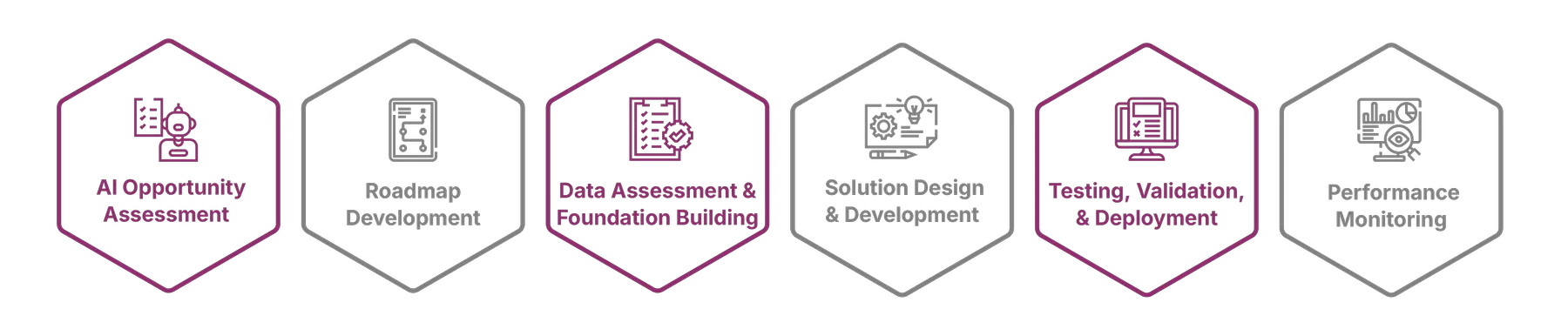
Step 1: AI Opportunity Assessment and Prioritization
We begin by conducting a structured assessment of your business processes, data assets, strategic objectives, and technology environment to identify the AI opportunities most likely to deliver meaningful value in your specific context. This assessment produces a prioritized list of AI use cases ranked by potential impact and implementation feasibility.
Step 2: AI Strategy and Roadmap Development
Using the findings from the opportunity assessment, Al Mawaleh develops a clear AI strategy and phased implementation roadmap that sequences AI initiatives logically, delivers early returns to build organizational confidence, and builds toward longer-term AI capability development aligned with your business objectives.
Step 3: Data Assessment and Foundation Building
We assess the quality, availability, and structure of the data assets required to support your prioritized AI use cases. Where data foundation improvements are needed, Al Mawaleh develops practical plans for data collection, cleansing, structuring, and governance that create the reliable data environment that effective AI requires.
Step 4: Solution Design and Development
Our AI specialists design and develop solutions tailored to your specific use cases, selecting appropriate algorithms, frameworks, and platforms based on the nature of the problem being solved and the constraints of your technology environment. Every solution is developed with integration, scalability, and long-term maintainability as core design principles.
Step 5: Testing, Validation, and Deployment
Before deployment, every AI solution undergoes rigorous testing and validation to ensure it performs accurately, reliably, and in alignment with the business requirements it was designed to address. Al Mawaleh manages the deployment process carefully, ensuring that new AI capabilities are introduced in a controlled manner that minimizes disruption to ongoing operations.
Step 6: Performance Monitoring and Continuous Improvement
Following deployment, Al Mawaleh monitors AI solution performance, tracks outcomes against defined success metrics, and implements continuous improvements as the system accumulates more data and as business requirements evolve. We provide regular performance reports and strategic reviews that keep management informed about the value being generated by AI investments.
Oman Vision 2040 and the National AI Agenda
Oman Vision 2040 identifies artificial intelligence as a strategic national priority, with specific programs and investments designed to accelerate AI adoption across both the public and private sectors. The government’s commitment to building a knowledge-based, technology-driven economy creates a highly supportive environment for businesses investing in AI, with growing access to AI talent, infrastructure, and partnership opportunities aligned with national development objectives.
Information Technology Authority
The Information Technology Authority plays a central role in shaping Oman’s digital and AI development agenda, setting standards for data governance, digital infrastructure, and technology adoption across both government and private sector organizations. Businesses implementing AI solutions should ensure their data management practices and AI governance frameworks align with ITA guidance applicable to their sector and use cases.
Responsible AI and Ethical Considerations
As AI adoption accelerates in Oman, the ethical dimensions of AI deployment, including algorithmic fairness, transparency, accountability, and data privacy, are receiving increasing attention from regulators, business leaders, and the public. Al Mawaleh incorporates responsible AI principles into every implementation engagement, helping businesses deploy AI in ways that are technically effective, ethically sound, and aligned with the governance expectations of Omani regulators and international best practice standards.
Data Protection Framework
The responsible use of data is fundamental to both ethical AI deployment and emerging regulatory expectations in Oman. Businesses implementing AI solutions must ensure that data collection, storage, processing, and use practices meet applicable data protection standards and that AI systems are designed to handle personal and sensitive information in a manner that respects individual privacy rights and organizational data governance obligations.
Al Mawaleh delivers artificial intelligence services to businesses across a wide range of industries in Oman:
| Document | Purpose |
|---|---|
| Business process documentation and workflows | Identify automation and AI enhancement opportunities |
| Data inventory and data management documentation | Assess data quality, availability, and suitability for AI |
| Existing technology infrastructure and system details | Design AI solutions compatible with current environment |
| Strategic business plan and growth objectives | Align AI roadmap with long term commercial direction |
| Current reporting and analytics capabilities | Identify gaps that predictive analytics can address |
| Sample datasets relevant to priority use cases | Assess data quality and inform solution design |
| Regulatory and compliance obligations | Ensure AI solutions meet all applicable governance requirements |
| Previous technology project records if available | Learn from historical implementation experience |
Challenge
A leading insurance company in Muscat was processing thousands of claims manually each month, with a team of staff reviewing documentation, verifying information, assessing eligibility, and making approval decisions through a time-consuming and largely paper-based workflow. Processing times were long, customer satisfaction scores related to claims handling were consistently below management targets, and the cost per claim processed was significantly higher than regional industry benchmarks.
Solution
Al Mawaleh conducted an AI opportunity assessment focused specifically on the claims processing workflow, analyzing the process in detail, assessing the quality and structure of available claims data, and evaluating the feasibility of intelligent automation across different stages of the claims lifecycle. We developed a phased AI implementation plan covering three components: an intelligent document processing system that automatically extracted and validated information from submitted claims documentation, a machine learning model that assessed claim eligibility and recommended approval decisions based on policy terms and historical claims data, and a natural language processing tool that analyzed customer communications to prioritize and route claims requiring urgent attention.
Outcome
Within six months of full deployment, average claims processing time had reduced by 64 percent. The intelligent document processing system was handling over 80 percent of standard documentation extraction automatically, with accuracy rates exceeding the previous manual process. The machine learning eligibility model was correctly recommending approval decisions on routine claims at a rate that allowed claims staff to focus their judgment on complex and exceptional cases rather than routine processing.

Al Mawaleh is ready to help your organization harness the genuine transformative potential of artificial intelligence in Oman. Whether you are exploring AI for the first time or looking to accelerate and expand an existing AI program, our team provides the strategy, expertise, and implementation support your business needs to turn AI ambition into measurable business results.