- Welcome to Al-Mawaleh
- Majan building , Opposite CSK cafe ,Ghala,Muscat Governorate,Sultanate of Oman

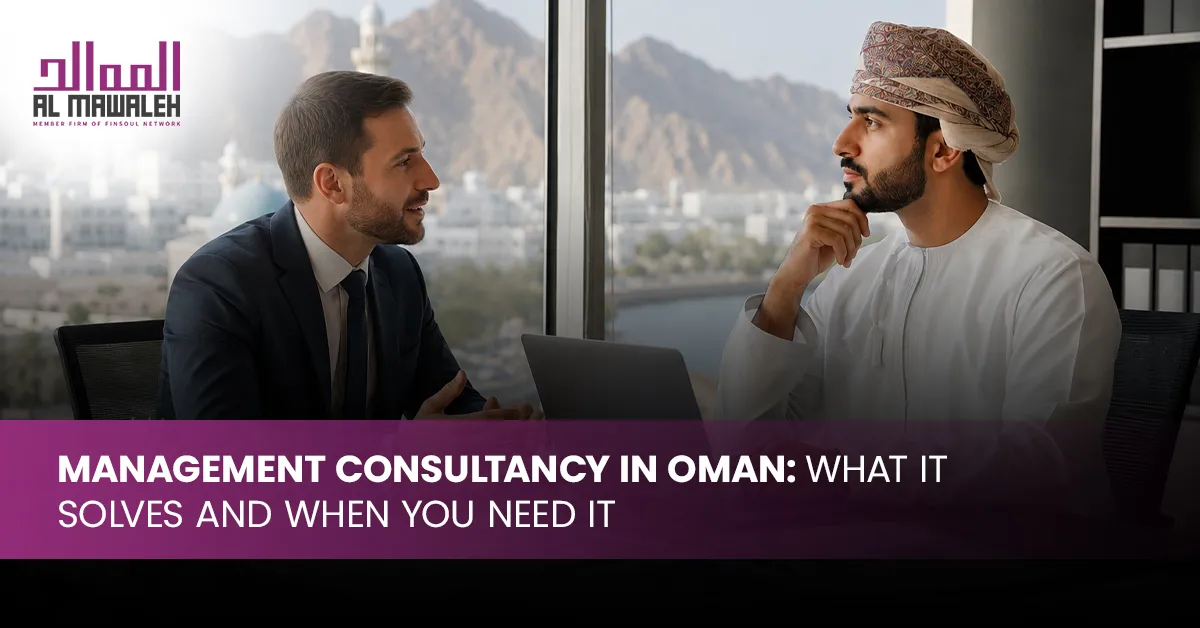
Oman’s economy is diversifying fast, and with that shift comes real pressure on local businesses to operate more efficiently, plan more carefully, and compete on more than just relationships. This is exactly where management consultancy in Oman earns its keep. Whether you’re a family-owned trading house in Muscat or a growing SME in Sohar, the right advisor can turn a vague sense of “something isn’t working” into a clear, actionable plan. At Al Mawaleh, we’ve seen firsthand how the right kind of outside perspective, applied at the right moment, changes the trajectory of a business.
This guide walks through what management consultancy actually solves, the signals that tell you it’s time to bring someone in, and how to choose the right partner in Muscat. If you’ve ever wondered whether management consultancy in Oman is worth the investment for a business your size, the sections below should make that decision a lot clearer.
Not every engagement looks the same, but most management consultants Oman businesses hire fall into a handful of recurring categories:
Good business consulting services Oman providers rarely tackle these in isolation. A supply chain problem is often, underneath, an organizational design problem, and a strategy engagement without operational follow-through tends to stall out within a year.
Businesses rarely call a consultant because everything is going well. More often, it’s because a few warning signs have piled up:
If two or more of these sound familiar, that’s usually the point where management consultancy in Oman stops being a nice-to-have and starts being a practical necessity. Left unaddressed, small inefficiencies compound quietly over several quarters until they show up as a much bigger, much costlier problem.
People often use these terms interchangeably, but they’re not the same thing, and mixing them up can lead to hiring the wrong partner for the job.
Financial advisory is narrower and typically deals with capital structure, audits, tax planning, fundraising, and compliance. It’s about the numbers themselves: are they accurate, are they optimized, are they compliant with Omani regulations
Management consultancy, by contrast, looks at how the business actually runs: its strategy, its structure, its processes, and its people. A management consultant might use financial data as evidence, but the recommendations go beyond the balance sheet into how work gets done.
In practice, a strong business advisory Oman relationship often blends both. A consultancy might bring in financial specialists for a due diligence phase, or a financial advisor might flag operational issues that need a broader consulting engagement. This overlap is exactly why some business consultancy firms in Oman now build in-house financial teams rather than referring clients elsewhere; it keeps the whole picture under one roof. The key is knowing which problem you actually have before you sign a contract. A cash flow issue needs a different fix than a structural one.
Engagements with a management consultancy in Oman generally fall into a few structures:
Engagement Model | Typical Timeline | Description | Best For |
Diagnostic or Assessment Projects | 2–6 weeks | A focused review of a specific business function, ending with a report that includes prioritized recommendations and improvement opportunities. | Businesses that want to assess challenges before committing to a larger consulting project. |
Fixed-Scope Implementation Projects | 3–6 months | Consultants work on solving a defined business challenge, such as redesigning procurement processes, improving operations, or implementing a performance management framework. | Organizations with clearly defined objectives that require structured implementation support. |
Retained Advisory | 6–12 months (or ongoing) | A consultant works alongside leadership on a part-time basis, providing continuous strategic guidance during periods of growth, transformation, or restructuring. | Companies undergoing long-term organizational change or expansion. |
Interim Leadership | Varies based on business needs | An experienced consultant temporarily fills a senior leadership position until a permanent executive is appointed. | Businesses facing leadership transitions or requiring temporary executive expertise. |
A consultancy engagement without measurable outcomes is really just an expensive conversation. Reputable management consultants Oman firms typically track impact through:
Ask any prospective advisor how they plan to report progress before you sign anything. If the answer is vague, that’s a signal worth taking seriously.
Muscat has no shortage of consultants, but not all of them are equipped for the same kind of work. When evaluating a management consultancy firm in Muscat, consider:
This is a fair benchmark to apply to any firm offering business consultancy Oman businesses are considering working with, and it’s the standard worth insisting on before signing a contract.
It also helps to ask how a prospective firm defines success at the outset. A good business advisory Oman partner will want measurable goals agreed before the first invoice, not after the final report. That single conversation, more than any brochure or pitch deck, tends to reveal whether a firm is genuinely built for long-term partnership or just for one-off projects.
Bringing in outside expertise isn’t an admission that something is broken; it’s usually a sign that a business has outgrown its current way of operating and is ready for the next stage. Whether you need a short diagnostic or a longer restructuring partnership, the right management consultancy in Oman should leave you with a clearer, more resilient business than the one you started with. At Al Mawaleh, that’s the outcome we work toward with every client relationship, one honest conversation at a time.
The cost of management consultancy services varies depending on the scope and complexity of the project. Short-term diagnostic assessments may cost only a few thousand Omani rials, while comprehensive, long-term consulting engagements typically require a larger investment. Most consulting firms provide a fixed-fee quotation after assessing your business requirements.
Project timelines depend on the nature of the engagement. Diagnostic assessments may be completed within a few weeks, whereas business transformation, restructuring, or implementation projects often take three to six months or longer.
No. Management consultancy services are valuable for businesses of all sizes, including SMEs and family-owned enterprises. Many consulting firms offer scalable solutions and fixed-fee assessments designed to meet the needs and budgets of smaller organisations.
Although the terms are often used interchangeably, a business advisor typically provides ongoing strategic guidance, while a consultant is usually engaged for a specific project, challenge, or business objective. However, consultants may also offer long-term advisory services when required.
If your primary concern involves financial planning, compliance, taxation, funding, or investment decisions, financial advisory services are generally the better choice. If your focus is on improving operations, business strategy, organisational performance, or process efficiency, management consultancy is typically more appropriate.