- Welcome to Al-Mawaleh
- Majan building , Opposite CSK cafe ,Ghala,Muscat Governorate,Sultanate of Oman

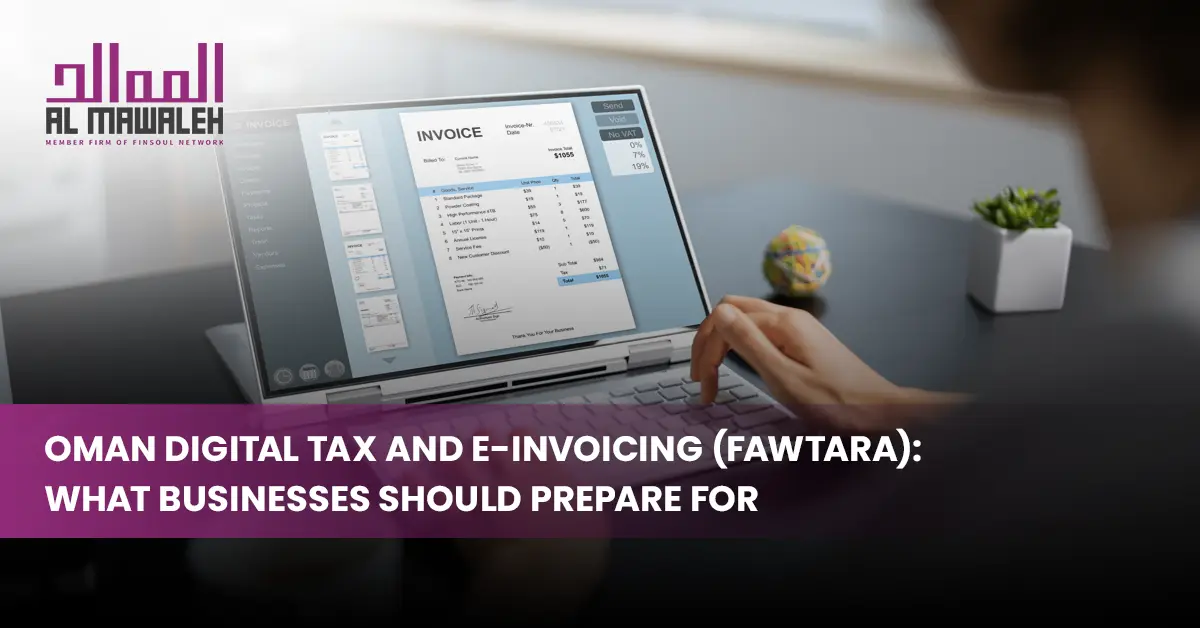
Oman is entering a new era of tax administration, and Al Mawaleh wants every business owner in the Sultanate to understand what’s coming. Oman digital tax and e-invoicing reforms, delivered through the national Fawtara program, are reshaping how companies issue, exchange, and report invoices. If you run a VAT-registered business, this shift is no longer a distant policy discussion; it’s an operational deadline with real consequences for how you bill customers and report to the Oman Tax Authority (OTA).
This guide breaks down everything you need to know about Oman e-invoicing, from the phased rollout timeline to the practical steps your business should take today.
For years, Omani businesses relied on paper invoices, spreadsheets, and PDFs to manage billing. That approach is ending. This reform requires structured electronic invoices that are validated, exchanged, and reported through an official digital system rather than emailed or printed manually. The goal behind Oman digital tax reform is straightforward: reduce tax fraud, close revenue gaps, speed up VAT reporting, and bring Oman in line with regional neighbors like Saudi Arabia and the UAE, both of which already enforce mandatory e-invoicing systems of their own.
This transition also reflects a broader push toward Oman digital tax modernization across government services, aligning invoicing with the country’s wider digital economy ambitions. Businesses that grasp the full scope of this reform early will find the eventual transition far smoother than those who wait until their compliance deadline is weeks away.
Fawtara, the Arabic word for invoice, is the OTA’s national e-invoicing platform. It’s the engine behind Oman digital tax and e-invoicing compliance. Under Fawtara, invoices are created through accounting or ERP software, validated automatically, exchanged between trading partners, and reported directly to the OTA as structured Tax Data Documents. Rather than a simple PDF attachment, a compliant invoice becomes a machine-readable data record that both the buyer and the tax authority can trust instantly.
The OTA officially became a Peppol Authority in January 2026, and it published the PINT Oman technical specification shortly after, cementing the technical backbone of the program.
Oman e-invoicing isn’t launching all at once. The OTA has designed a gradual rollout so businesses of every size have time to adapt:
Even if your business isn’t in the first wave, Oman digital tax and e-invoicing obligations will eventually reach nearly every VAT-registered entity, so early preparation avoids a last-minute scramble.
Fawtara uses a five-corner model built on the international Peppol network. The model connects businesses, service providers, and the Oman Tax Authority (OTA) to ensure invoices are securely exchanged, validated, and reported.
Corner | Participant | Role |
Corner 1 | Seller | Creates and issues the electronic invoice through its accounting or ERP system. |
Corner 2 | Seller’s Accredited Service Provider | Converts, validates, and securely transmits the invoice in the required format. |
Corner 3 | Buyer’s Accredited Service Provider | Receives and processes the invoice before delivering it to the buyer. |
Corner 4 | Buyer | Receives the compliant e-invoice through its service provider. |
Corner 5 | Oman Tax Authority (OTA) | Receives the required invoice and tax data for reporting and compliance purposes. |
This model means businesses generally do not connect directly to the OTA. Instead, an accredited service provider manages invoice formatting, validation, exchange, and secure transmission on the business’s behalf.
Choosing the right accredited service provider is therefore one of the most important decisions in your Fawtara readiness plan.
This mandate applies to VAT-registered businesses of all sizes, though the timeline determines when each group must act. Large taxpayers face the earliest deadlines, SMEs follow in the third phase, and government-related transactions come last. Non-resident businesses that hold Oman VAT registration are also expected to fall under the mandate. No permanent exemptions have been announced, so nearly every VAT-registered entity should assume compliance is a matter of when, not if.
Sector doesn’t shield anyone from the mandate either. Retail, construction, logistics, professional services, and manufacturing companies are all expected to be pulled into Oman digital tax compliance as their phase arrives. Even businesses that primarily transact business-to-consumer (B2C) should watch OTA guidance closely, since reporting expectations for that segment are still being clarified. If you’re unsure where your company falls, the safest assumption is that a deadline is coming, and the only real variable is how much time you have left to prepare.
It’s also worth noting that group structures and multi-branch companies may need to think through compliance holistically rather than branch by branch. If different branches share a single VAT registration, invoicing workflows, ERP configurations, and service-provider connections generally need to be coordinated centrally so that reporting to the OTA stays consistent across the entire entity.
Preparing for Oman digital tax and e-invoicing doesn’t have to be overwhelming if you break it into manageable stages:
Many companies underestimate the technical lift required for Oman digital tax and e-invoicing compliance. Common hurdles include outdated ERP systems that can’t generate structured XML or UBL-format invoices, incomplete customer and product data, unfamiliarity with Peppol-based exchange, and uncertainty about which service provider to trust. Cross-border businesses also face added complexity around import transactions, which must be reported as separate invoices under current OTA guidance. Planning ahead rather than waiting for your phase deadline is the single best way to avoid these pitfalls.
Early adoption of Fawtara can provide several important benefits for businesses:
Oman’s e-invoicing transition is already underway, and businesses that prepare early will be better positioned to avoid compliance issues, invoice disruptions, and last-minute system changes. Whether you’re a large taxpayer preparing for Phase 1 or an SME getting ready for Phase 3, now is the right time to review your invoicing processes and technology.
Al Mawaleh can help your business understand the Fawtara requirements, assess your current invoicing setup, and prepare for a smooth transition to Oman’s digital tax environment.
Get ready for Fawtara today and keep your business compliant, connected, and prepared for what’s next.
Location
Majan Building, Opposite CSK Cafe, Ghala, Muscat Governorate, Sultanate of Oman
Email
info@mawaleh.com
Phone
+968 7733 8545
Oman digital tax and e-invoicing reform is one of the most significant compliance shifts Omani businesses will face this decade. The phased timeline gives companies breathing room, but the technical and operational changes are substantial enough that waiting until the deadline is risky. Whether you’re a large enterprise entering Phase 1 or an SME with more time before Phase 3, the smartest move is to start auditing your systems, choosing a service provider, and testing your invoicing workflow now. Al Mawaleh encourages every business in Oman to treat this transition seriously; getting ahead of Fawtara today means avoiding disruption tomorrow.
Fawtara is Oman’s national e-invoicing and digital tax reporting platform, run by the Oman Tax Authority using a Peppol-based five-corner model.
The first phase begins in August 2026 for around 100 large taxpayers, expanding to all VAT-registered businesses by August 2027.
Yes. SMEs are expected to fall under Phase 3, starting August 2027, though exact scope details may still be refined by the OTA.
No. Once a business is onboarded to Fawtara, only compliant e-invoices issued through an approved system will be accepted.
Invoices must use structured formats such as XML (UBL 2.1) aligned with the PINT Oman specification, rather than plain PDFs or scanned documents.